
Course Guideline for “Learning by Practice”
Course Guideline for “Learning by Practice”
104.10.28 Revised by Committee of General Education
1. Based on Title 19 of NCKU Learning Regulations, “Learning by practice” Course Guideline (referred to as Guideline hereafter) is designed to enable students to understand the meaning of learning in daily life by engaging in daily practices and to foster a commitment to lifelong learning.
2. The Committee of Consultants is established by the Director of the Center for General Education (CGE) to carry out the Guideline.
3. “Learning by practice” is a cluster of courses, and students may take a maximum of 6 credits, i.e. 54 points. The cluster includes two groups of courses. The first one includes three 2-credit-courses, each consisting of 18 points: “Learning by Practice I”, “Learning by Practice II”, and “Learning by Practice III”. The second group includes six 1-credit-courses, each consisting of 9 points: “Learning by Practice A”, “Learning by Practice B”, “Learning by Practice C”, “Learning by Practice D”, “Learning by Practice E”, and “Learning by Practice F”.
Students may gain points from the following four learning categories:
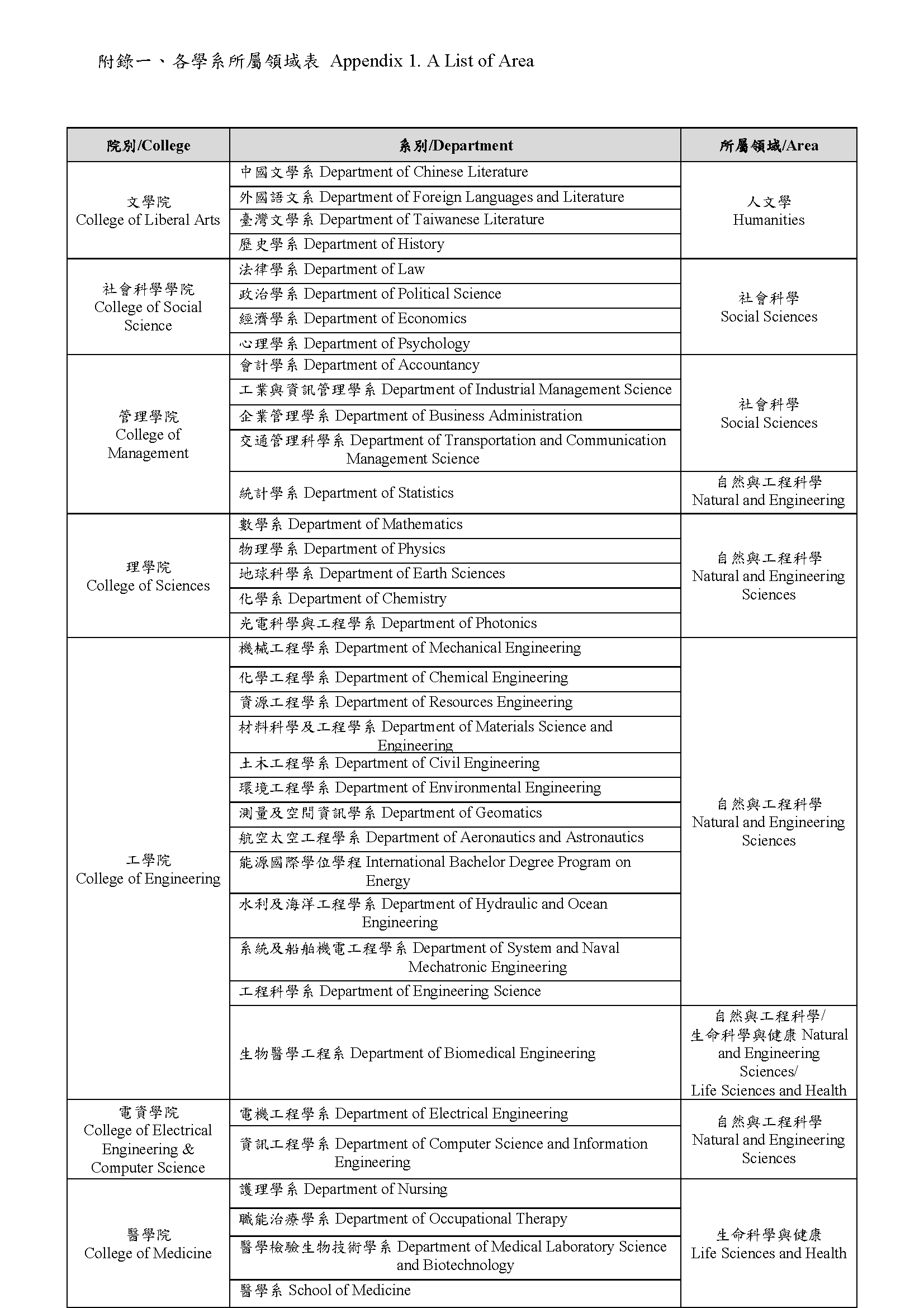
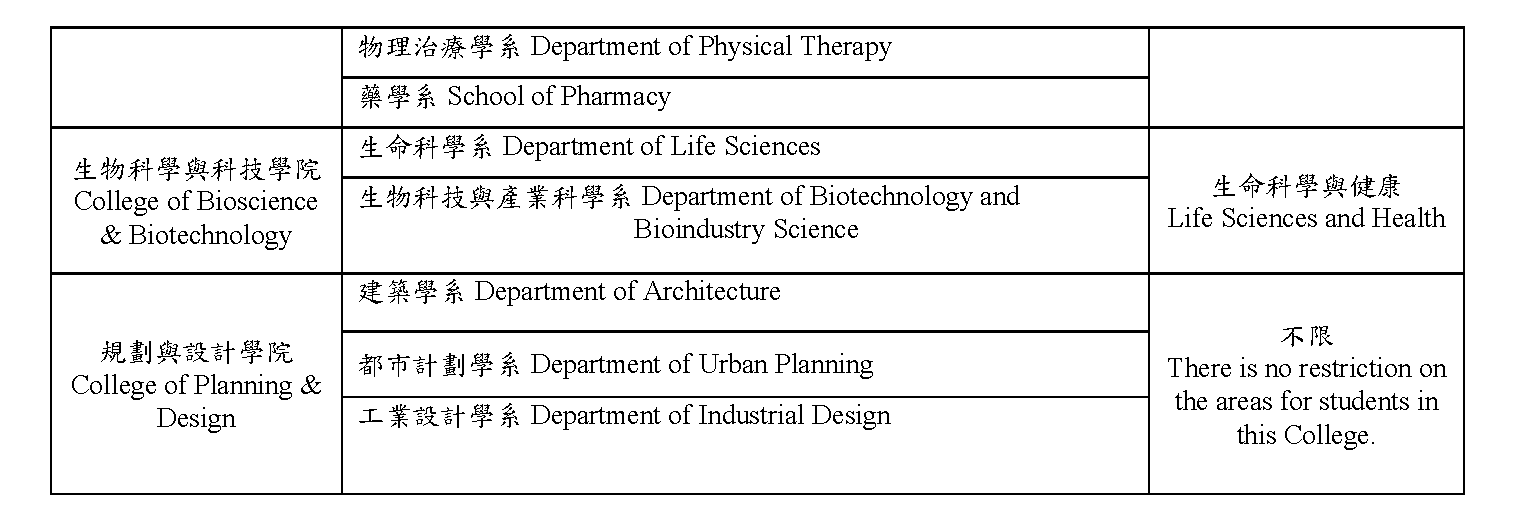
1) Self-Learning contains three types of activities: reading classics, attending CGE-approved lectures, and doing online foreign language self-learning. However, if the feature of lectures belongs to a student's major area (see Appendix 1), he/she can only earn a maximum of 3 points per 1-credit-course.
2) Work-Learning contains four types of activities: intern/working experience, military service, skill contests, and vocational licenses.
3) Overseas-Learning
4) Praxis-Learning contains three types of activities: leadership in extracurricular clubs, campus volunteering, and talk show/individual performances. This category can earn a maximum of 6 points per 1-credit-course.
Concerning other types of self-learning activities that are not included above, departments/administrative units may define an activity as appropriate and request special recognition of that activity. Upon request, the Center's Faculty Meeting will determine if and how points will be given, according to the content and the nature of the activities.
Except in the case of online foreign language self-learning, which are limited to 2 points per credit, students may gain a maximum of 6 points per credit for each activity from within the above categories one, two, and three.
4. Grading: Concerning the four learning categories, the evaluation standards are listed as follows:
1) Self-Learning:
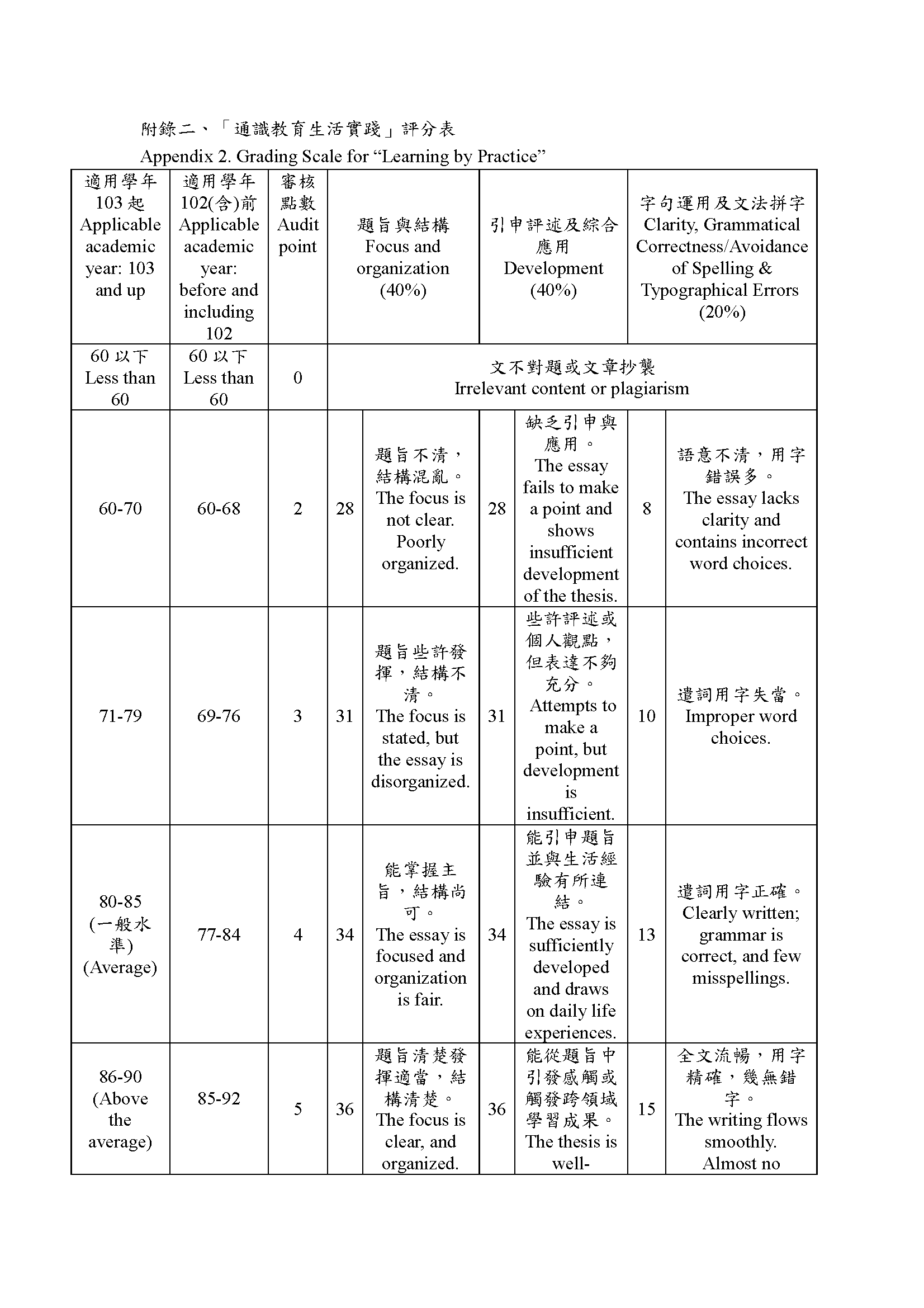
a. Reading Classics: The lists of classic books by major areas are provided by the Committee of General Education and announced online at the beginning of every academic year. The chosen book must not belong to a student’s major area, and after reading it the student must submit an essay with a minimum of 3000 words. Submission is limited to one essay per week and a maximum of 6 points per essay can be earned. The points are given based on the following standards (Grading scale is in Appendix 2.):
A score of 59 and below is equivalent to 0 points
A score of 60~70 is equivalent to 2 points
A score of 71~79 is equivalent to 3 points
A score of 80~85 is equivalent to 4 points
A score of 86~90 is equivalent to 5 points
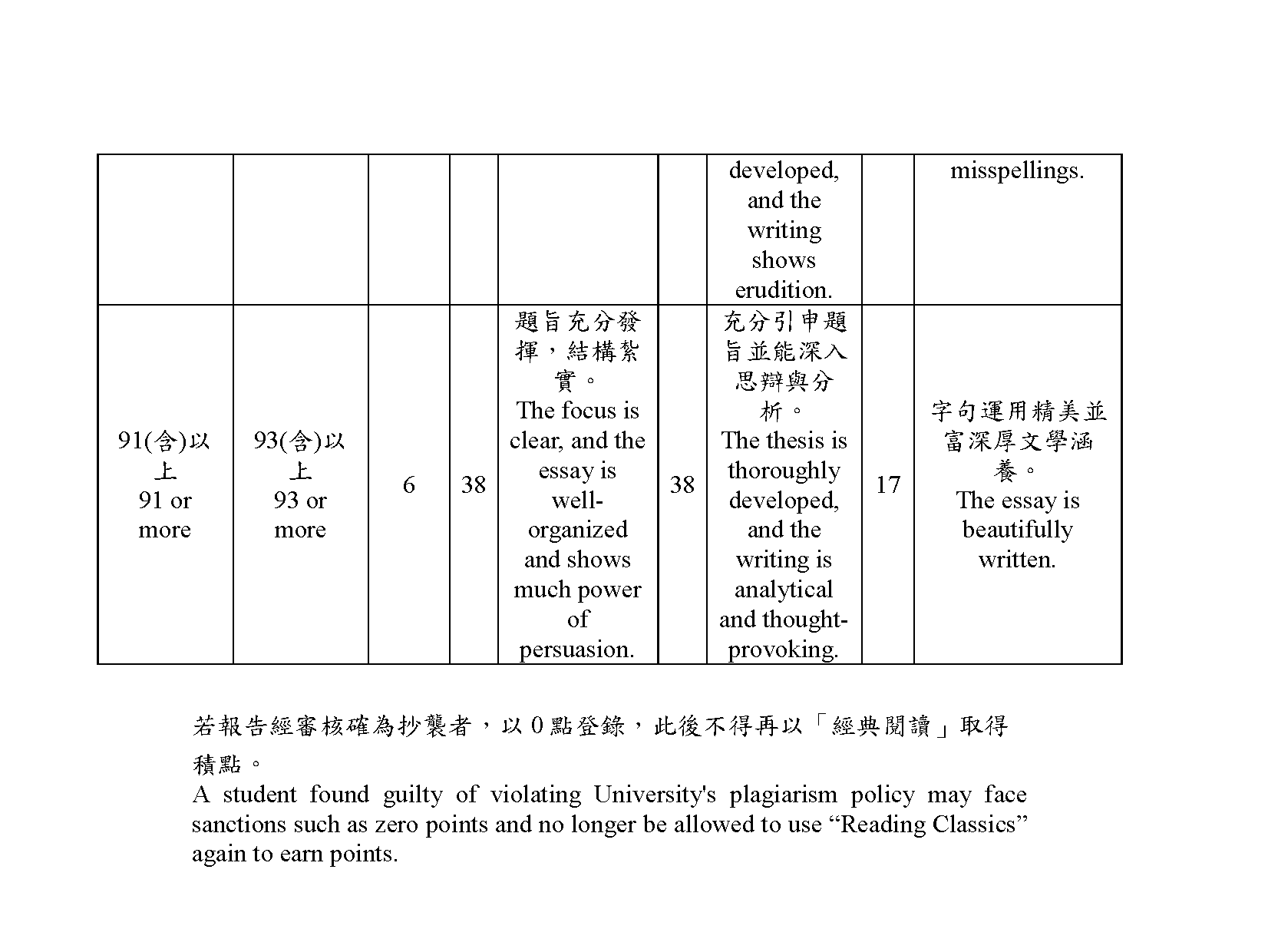
A score of 91 and above is equivalent to 6 points.
A student found guilty of violating University's plagiarism policy may face sanctions such as receiving zero points and no longer be allowed to use “Reading Classics” again to earn points.
b. Attending Lectures: Students who attend a CGE-approved lecture must have their login and logout history and after attending the lecture he/she must submit a reflection essay with a minimum of 1000~1500 words and upload it to the CGE website within two weeks. The points are given based on the following standards (Grading scale is in Appendix 2.):
A score of 59 and below is equivalent to 0 points
A score of 60~89 is equivalent to 1 point
A score of 90 and above is equivalent to 2 points.
c. Online Learning: Students who participate in an online program must provide a record to indicate their login and logout history or total online learning time, which can be downloaded from the online language learning system of Library’s media center. One hour of online self-learning is equivalent to 0.5 point.
2) Work-Learning: (The certificates can be obtained in the summer prior to enrollment.)
a. Intern/working experiences: Students have to provide a full-time work certificate or income tax payment certificate from summer/winter break. Every month of full-time intern/work can earn 2 points. Working over 15 days and less than a month can earn 1 point; less than 15 days does not receive any points.
b. Military service: students have to provide a copy of official military service certificate. Every two months of service can earn 1 point.
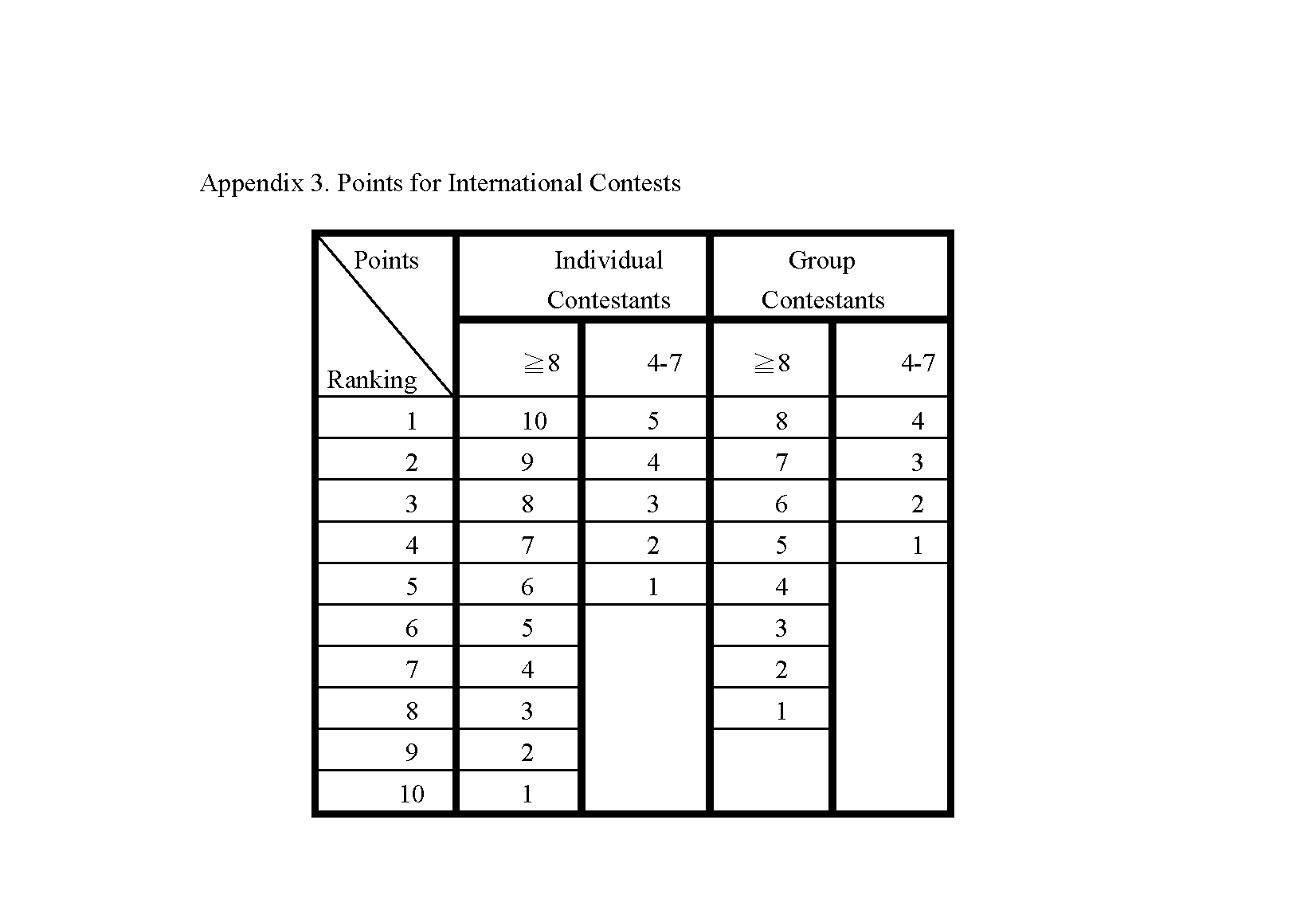
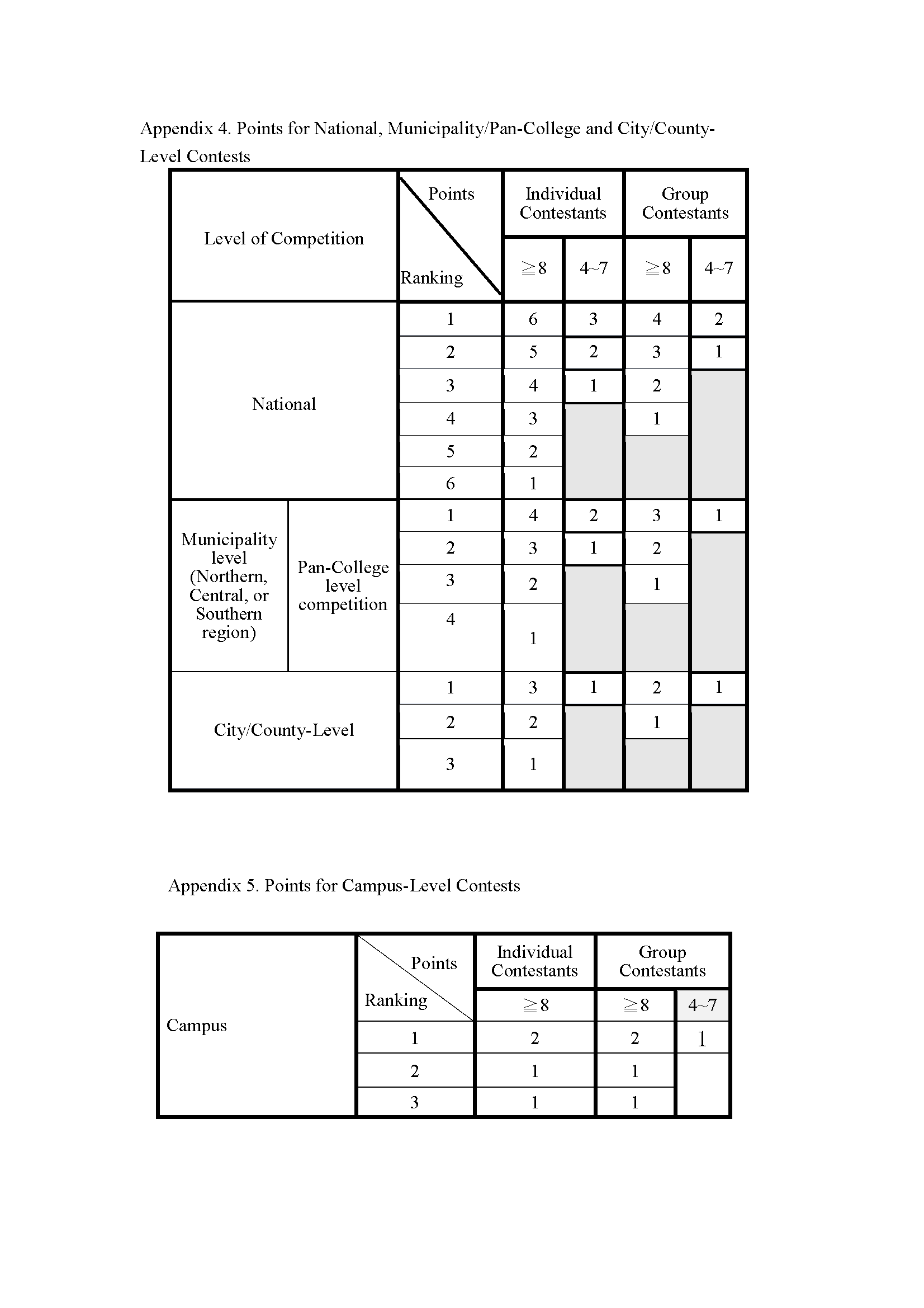
c. Skills contests: Students may refer to Appendixes 3, 4, 5 for points that can be earned. Documents should be provided, such as a picture of a trophy, certificate, team list, etc., so the points can be awarded. Each contest is limited to be awarded points for the top prize.
d. Vocational license: students have to provide a copy of official license issued by the Taiwanese government. Points vary according to type of license. For example, C class technician license can earn 6 points and B class can earn 12 points.
3) Overseas-Learning: (The certificates can be obtained in the summer prior to enrollment.)
Students have to provide travel documents, such as itinerary, passport or departure/arrival record, and an essay of at least 1000 words in order to earn a maximum of 6 points for visiting a particular country. (The grading scale is in Appendix 2.) However, students who participate in an overseas internship and apply for working experience points, or international students who visit their home countries, are not qualified for this category.
4) Praxis-Learning:
a. leadership in an extracurricular club: students holding a leadership position in an extracurricular club are qualified to submit their Leadership Learning Evaluation Forms to the Office of Extracurricular Activity in the Office of Student Affairs. For more details regarding the rules for earning points, please visit Office of Extracurricular Activity website. Non-campus clubs may use the same form to apply.
b. campus volunteering: students who are campus volunteers need to provide a volunteer certificate to earn points. Every two hours of volunteer work can earn 1 point.
c. talk show/individual performance: students planning a public performance have to have the location approved by CGE and must perform for at least 10 minutes in public, and the performance must be recorded and submitted to CGE to earn 1 point.
5. Course Registration: After earning a total of 9 points, students may register “Learning by Practice” course by the 16th week of the semester. The course registration procedure is as follows: Students need to submit their course passports to CGE and receive a Certificate of Registration. With the Certificate, students need to go the registrar’s office to complete registration and pay the credit fees if needed.
6. Course Grade: All grades for the courses, “Learning by Practice I”, “Learning by Practice II,” “Learning by Practice III”, must be marked as “TR” to indicate the completion of a 2-credit-course.
“Learning by Practice A,” “Learning by Practice B,” “Learning by Practice C,” “Learning by Practice D,” “Learning by Practice E,” and “Learning by Practice F” must be marked as “TR” to indicate the completion of a 1-credit- course.
7. The Guideline is compiled, approved and, when necessary, revised by the Committee of General Education.
 06-2766417
 em50210@email.ncku.edu.tw
 701台南市東區大學路1號(光復校區雲平大樓東棟)